

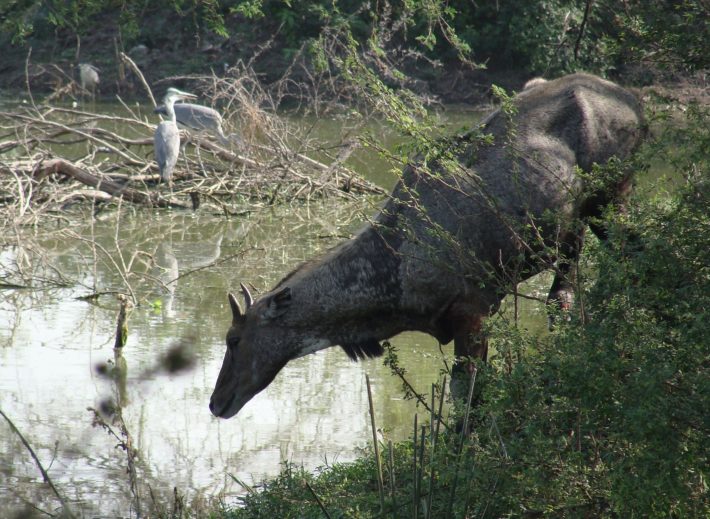
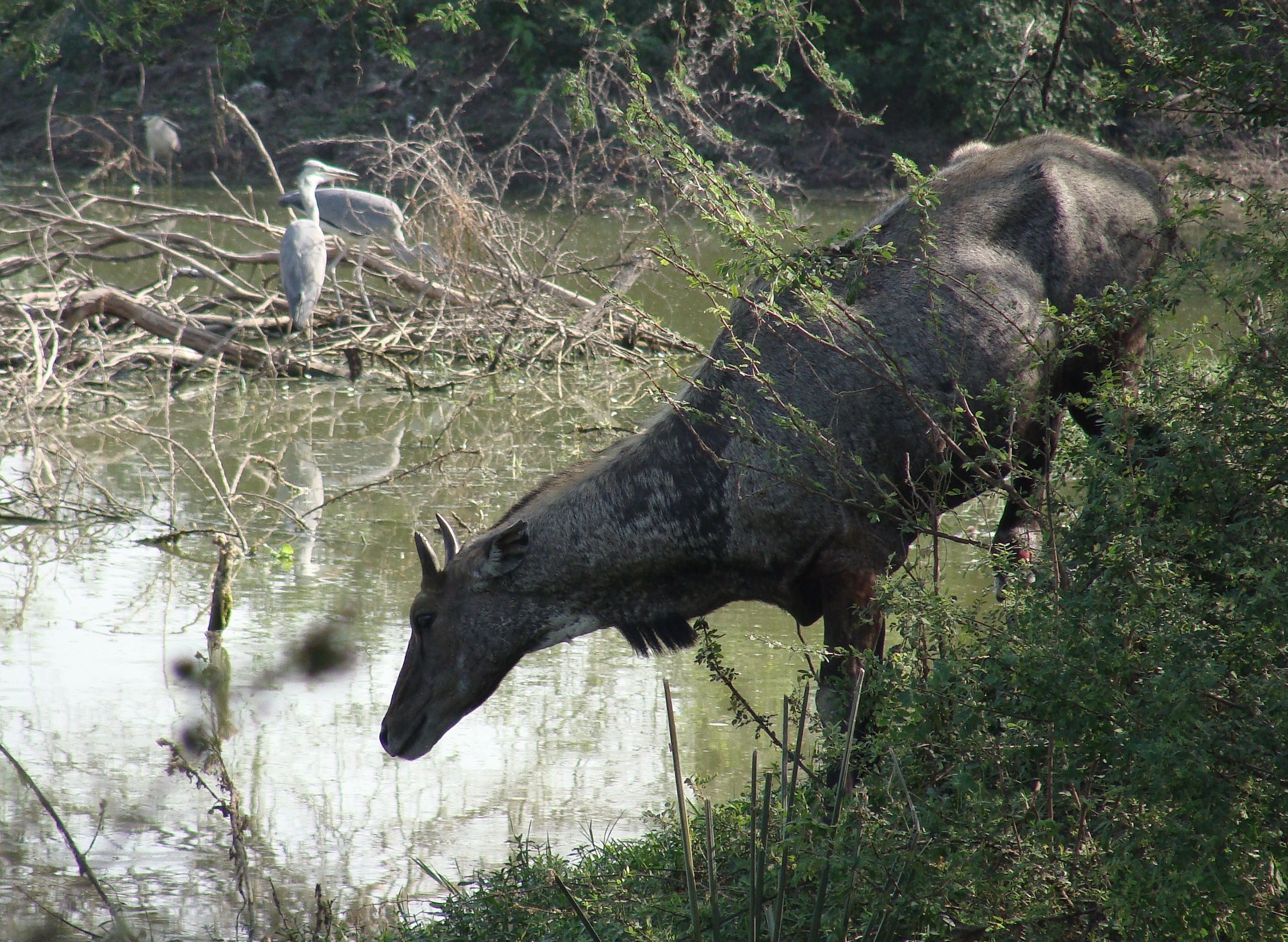
As my jeep crested the dune on the desert track, I saw the nilgai for the first time. There were thirteen of them, led by a magnificent blue buck. Some smaller deer and sprinkling of fawns followed tentatively behind, feeding on the shrubs that dotted the landscape. As my jeep came in the line of sight of their vision, they paused in their feed, and instinctively bunched closer together. Then with languid grace they slipped away through the thicket, disappearing from view across a desert dune.
I saw them many times in my sojourns through the desert. Each time, the poise and dignity of their movements instilled in me a sense of peace and serenity. With time I began to identify with them and their routine. They usually emerged at dawn in a small hollow amongst the dunes, virtually invisible in the shimmering sands. As they fed amongst the shrubs, the blue buck would stand regally aside, his ears testing the wind for danger. In the scorching heat of the afternoons, I would spot them nestling in the densest thicket of acacia shrubs, and sometimes at night I could hear them snorting and shuffling as they moved in search of their feed.
The vast herds of chinkaras and cheetal that once roamed the landscape had dwindled and disappeared long since. The nilgai, with their supposed affinity to cows survived; protected unwittingly by the religious connotations of the name their greatest enemy had accorded them. Yet, they had their enemies. Sometimes at night, shots would ring out, followed by the anguished barking of an injured deer, and the frenzied snorting of the frightened herd. Then for weeks thereafter they would disappear. When they reappeared their movements were tentative, their feeds frugal and incomplete, and their habitat much further away from our camps.
Progress at the construction sites, which were intruding into the open desert continued at a steady pace. The rolling dunes were levelled and the clumps of acacia trees bulldozed into the ground. In their place came up low, elongated barracks and squat, ugly tenements, which pockmarked the desert landscape. With each settlement that arose, the nilgai were pushed deeper into the desert, further from their grazing areas and natural habitat.
Gradually, the actions of the nilgai charged. Deprived of their natural feed, they began raiding the newly cultivated fields. Their nocturnal forays increased as their natural foraging grounds diminished. Then the shots rang out more often and their cries of anguish and periods of disappearance become more frequent.
I had not seen the herd for months now. They had moved deeper and were suspicious and scared. Sometimes, at night. I heard what seemed a familiar shuffling, but these were few and far in between. I saw them last, one desert twilight while on a reconnaissance in the deep desert. The construction sites had not moved so far as yet, and the landscape was fairly untouched. As always, the first to slip into view was the huge blue buck, keeping low across a dune, avoiding the horizon. He was different now, thinner, less assured in his movements and somehow less majestic. Nor was his herd the same. Three deer and one excited fawn foraged in the shrubs behind him – the pathetic remnants of the tribe that once roamed these dunes.
Over the horizon I could see smoke from the fires of the construction camp and the silhouettes of barracks. I turned my gaze to the deep desert towards the hollows where the herd had been. There were empty dunes there now, a sprinkling of shrubs and the slowly receding outline of the herd as they moved deeper into the inhospitable desert.
The construction camp inched its way deeper into the desert, slowly engulfing the spot where I last saw the herd. Barracks and sheds uprooted the scraggy, gnarled trees that had fought so hard for survival in this arid landscape, and a newly constructed canal cut through the dunes like an open gash. By day, the chug-chug of machinery and the hum of generators blended with the shouts of human voices. By night there would be singing around the campfires. Perhaps to mark another victory of man over nature.
Yet I feel no triumph. For in the midst of this activity the desert has always seemed emptier and more desolate, ever since.